Overview
Abstract
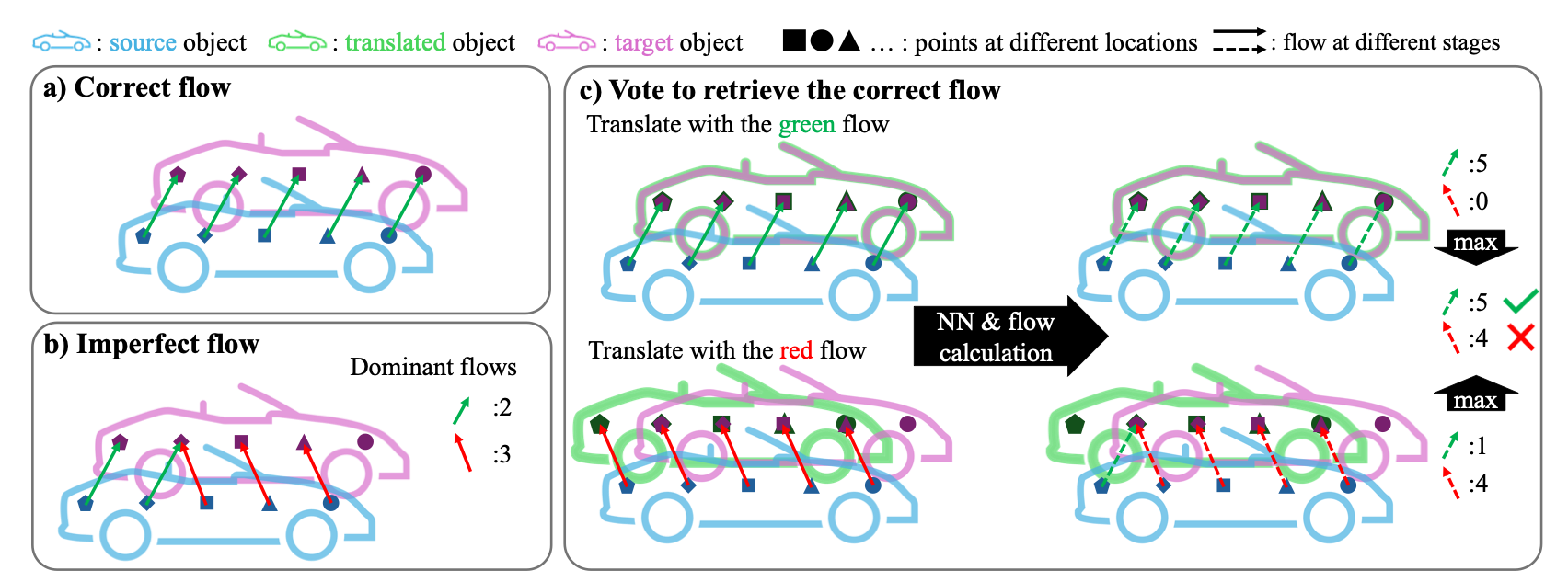
LiDAR scene flow estimates point-wise motion between two consecutive scans, referred to as the source and target. Leading self-supervised methods typically minimize the Chamfer loss, the nearest-neighbor distance between the flow-compensated source and the target. However, nearest-neighbor search does not enforce motion rigidity, often leading to inconsistent flows within object instances. Existing approaches address this issue with additional regularization terms, but flow consistency among points remains limited, especially for large objects. We propose RVLoss, a self-supervised loss that incorporates motion rigidity by design through a runoff vote mechanism. Our key observation is that the point-wise motion, calculated from nearest-neighbor search, can often be grouped into a small set of dominant flow candidates by voting (top-k voting). Furthermore, when compensating the source by these candidates, the flow that best represents the underlying rigid motion often yields the highest consensus after a second voting (top-1 voting). Based on this insight, we incorporate the two-stage runoff vote into loss design and create cluster-wise rigid flows and free-form flows as pseudo-labels for self-supervised learning. RVLoss can be seamlessly integrated into existing feedforward architectures. Experiments on the Argoverse2 2026 Scene Flow Challenge show that models trained with RVLoss achieve state-of-the-art performance among self-supervised approaches, outperforming baseline models trained with alternative loss designs by 20% and reducing the mean dynamic normalized end-point error from 0.202 to 0.163. Moreover, cross-dataset evaluations demonstrate consistent performance improvements across four additional datasets.
Highlights
Qualitative results
Scene flow

Error per point
Closer to ground truth
Argoverse 2 validation set. Both models use the DeltaFlow backbone; one is trained with the TeFlow loss, the other with RVLoss. Bird’s-eye view of 60 × 60 m around the ego vehicle (center, driving to the right), ground points removed, played at the original 10 Hz. Highlight clips are 5-second windows selected where RVLoss’s advantage is largest; full sequences are unedited and include frames where the TeFlow loss model is closer to the ground truth.
BibTeX
@inproceedings{wang2026rvloss,
  title     = {{RVLoss}: Runoff Vote Loss for Self-Supervised {LiDAR} Scene Flow Estimation},
  author    = {Wang, Shiming and Nan, Liangliang and Kooij, Julian F. P. and Caesar, Holger and Lin, Yancong},
  booktitle = {Advances in Neural Information Processing Systems (NeurIPS)},
  year      = {2026}
}